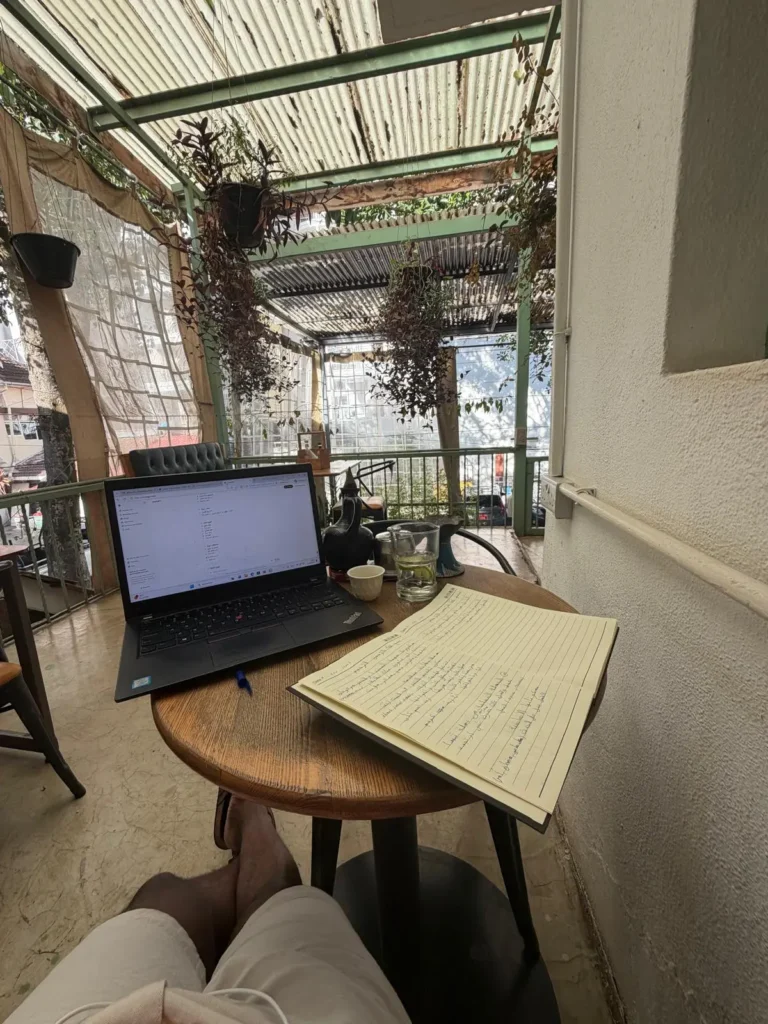
The charcoal is lit before anything else. Someone sets a low brazier down on the floor, feeds it, and waits for the coals to settle into an even orange. Nothing about the next three hours will be hurried, and that is the first thing to understand about buna.
Buna is the Amharic word for coffee. It is also the name of the ceremony built around it — performed daily in homes across Ethiopia and Eritrea, and bearing almost no resemblance to the way the rest of the world now drinks the same plant.
The room is prepared before the coffee
Fresh grass is cut and scattered across the floor, sometimes with small flowers pushed into it. Frankincense goes onto the coals and begins to smoke. A low stool appears, then a tray, then a cluster of small handleless cups set close together like eggs in a nest.
None of this is staging. The grass marks out the ground where people will sit; the incense signals that something has begun. By the time the coffee itself appears, the room has already been changed.
The beans are roasted in front of you

Green beans — raw, pale, faintly grassy — are washed and then tipped into a shallow metal pan held over the coals. They are shaken, constantly, for as long as it takes: pale to gold, gold to brown, brown to a dark and oily black that catches the light.
Then the pan is carried around the room, and each guest draws the smoke toward their face with a cupped hand. This is the part that surprises people who expected a demonstration. You are not being shown the coffee. You are being handed it, in its first available form, which is smell.
Grinding and brewing: the mukecha and the jebena
The roasted beans are pounded by hand in a heavy wooden mortar called a mukecha, struck with a long pestle until they break down to a coarse, fragrant grit. It is loud, rhythmic work, and it takes a while.
The grounds go into a jebena: a round-bellied black clay pot with a long neck and a straw lid, sat directly in the embers. When it boils, the coffee is poured out from a height into the waiting cups, in one continuous unbroken stream that somehow never seems to spill.
Three rounds, and each one has a name

The same grounds are brewed three times, and the three rounds are not interchangeable. Each is named, and each is weaker than the last.
- Abol — the first pour, and the strongest. Custom in many households is to serve the eldest person present before anyone else.
- Tona — the second, drawn from the same grounds with fresh water added. Lighter, and by now the conversation has usually loosened.
- Baraka — the third and weakest. The word means blessing.
You do not leave before baraka. The whole shape of the thing is an argument for staying.
What is served alongside
Popcorn, most often — a shared basket of it, passed around and eaten by the handful between cups. Depending on the household and the occasion, there may be roasted barley, bread, or something sweet. The food is not the point, but its presence is: it signals that this is a sitting, not a stop.
How long it takes
An hour at the very least. Two or three is normal. The roasting alone can run past twenty minutes, and none of the stages can be meaningfully rushed without the whole thing becoming something else.
This is the detail most often lost when the ceremony is described abroad. The duration is not an inefficiency to be tolerated. It is the mechanism. Three hours is how long it takes for a room of people to actually talk.
How coffee left Ethiopia
Coffea arabica is native to the Ethiopian highlands. The best-known origin story — a goatherd named Kaldi noticing his animals grow restless after eating certain red berries — is a legend, and a late one, but the botanical fact underneath it is not in dispute. The plant starts here.
From the highlands it crossed the Red Sea into Yemen, where it was cultivated in earnest and shipped out through the port of Mocha, a name that has since detached itself from the place entirely. Sufi orders drank it to stay awake through night prayer. From there it moved north into the Ottoman world, where the coffeehouse emerged as a genuinely new kind of public space, and then into Venice, and then everywhere.
It is now one of the most heavily traded agricultural commodities on earth, grown across three continents and priced on exchanges in New York and London. The same journey runs through the old trade corridors that carried silk, porcelain and pepper: a regional good becomes a global one, and the place it came from becomes a footnote in its own story.
The ceremony is not a performance
It is worth saying plainly, because the ceremony is frequently packaged for visitors and photographed as heritage: in most homes where buna happens, it is simply what happens. It occurs on ordinary afternoons, for no occasion, among people who have done it thousands of times.
Which is the quiet argument the whole ritual makes. Coffee travelled further than almost any crop in history and turned into a commodity measured in cents per pound. In the place it came from, it is still measured in hours, and in how many people are sitting down.